Startup Europe Support Programs
Startup Europe support programs encompass comprehensive initiatives that offer growth opportunities within the EU entrepreneurial ecosystem through grants, accelerators, and investment instruments.
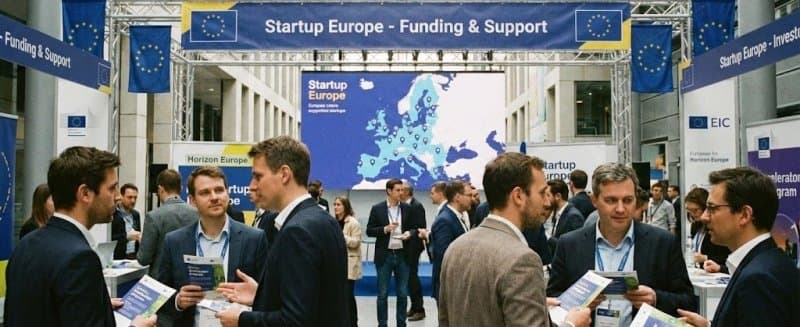

The European Union’s goal of scaling innovation-driven ventures is gaining momentum through the strategic coordination of grants, programs, and investment mechanisms under Startup Europe support programs. Comprehensive public–private partnerships make young technology companies’ internationalization, access to funding, and regulatory compliance more sustainable. Aligned with the Digital Single Market objective, this framework gives startups access not only to financing but also to visibility, market connections, and specialist expertise.
What Is the Main Purpose of Startup Europe Support Programs?
The main purpose of Startup Europe support programs is to prepare high-potential technology startups for accelerated growth within the European Union’s integrated innovation ecosystem. To achieve this, funding, mentorship, regulatory guidance, and international networking opportunities are brought together under a single framework.
While the framework offered by these programs reduces the obstacles early-stage teams encounter when scaling, it also gives strategic priority to technology fields that can enhance the competitiveness of the European market. Artificial intelligence, cybersecurity, deep tech, the green transition, energy technologies, and healthcare innovation are among the prominent areas.
Strategic Objectives
- Strengthening Europe’s position in the global innovation race
- Providing high-risk R&D funding to deep-tech developers
- Accelerating startups’ regulatory compliance
- Creating an integrated entrepreneurial network across member states
How the Core Benefits Translate into Practice
An EU-wide assessment reported that startup teams participating in accelerator programs secured investment an average of %27 faster. This finding shows that operational acceleration delivers not only educational benefits but also direct financial results.
What Structures Make Up the Startup Europe Program?
The Startup Europe program consists of four main structures designed in a modular format according to startups’ different stages and technical requirements. Each structure is updated in line with the innovation priorities set by the EU Commission.
1. Funding and Grant Programs
Funds that accelerate the growth capacity of early-stage startups generally cover R&D, prototyping, market validation, and scaling activities.
Types of Funding
- R&D-based grant funding
- Co-financing mechanisms
- Investment fund-backed equity instruments
- Market support grants for commercialization
By reducing financial risks, this structure enables innovative technologies to reach the market more quickly.
2. Accelerator and Incubation Mechanisms
The Startup Europe network offers an accelerator ecosystem that works in close integration with expert mentors, university laboratories, technical infrastructure providers, and private-sector investors.
Capacity-Building Areas Provided
- Product–market fit analysis
- Commercial strategy modeling
- Matching with institutional investors
- Technical roadmap optimization
Laboratory access and certification consulting provide significant advantages for teams operating in deep tech.
3. International Networking and Visibility Platforms
Access to entrepreneurial events, investor summits, and innovation fairs across Europe is one of the program’s strongest components. Startups can quickly build networks that are critical to their internationalization.
4. Regulatory and Market Compliance Consulting
Compliance consulting provides a critical risk-reduction framework, particularly for startups operating in artificial intelligence, healthcare technology, and financial technology.
Key Regulatory Areas
- GDPR data-processing requirements
- Artificial Intelligence Act compliance criteria
- Frameworks for digital service providers
- Sector-specific certification steps
Which Types of Startups Does Startup Europe Prioritize?
Startup Europe focuses on several categories of technology-based startups and designs distinct support mechanisms for each category. These priorities align with the EU’s long-term digital and sustainable transformation objectives.
Deep-Tech Startups
Deep-tech startups require specialized funding structures because of their complex R&D processes and high technical barriers. These ventures have a long time-to-market period, making continuity of grant funding critical.
Artificial Intelligence and Data Science Startups
The European Commission regularly renews high-budget calls for projects aimed at scaling the artificial intelligence ecosystem. Content generation, autonomous systems, security, energy optimization, and healthcare data analysis are among the themes frequently funded.
Technology Startups Focused on the Green Transition
Energy efficiency, the circular economy, and carbon measurement technologies hold a strategic position within the EU’s Green Deal objectives. Startups are offered testing infrastructure, validation facilities, and connections to pilot sites.
Healthcare Technology Startups
Digital health solutions, chronic disease management systems, remote diagnostic models, and biosensor-based devices are among the program’s priority areas.
Cybersecurity Startups
In line with Europe’s digital sovereignty strategy, security-focused startups receive advanced technical consulting to support their expansion into domestic and international markets.
Who Can Apply for Startup Europe Support Programs?
Technology teams operating in EU member states, candidate countries, or countries included in certain cooperation programs may apply for Startup Europe support programs. Although the criteria vary by program, the basic requirements share several common elements.
Basic Application Requirements
- Operating as a legally incorporated startup company
- Having verifiable technology at the product or prototype stage
- Presenting a business model that demonstrates market potential
- Demonstrating team capabilities that substantiate R&D capacity
When assessing a startup’s team structure, technical leadership, regulatory knowledge, and the clarity of its commercialization strategy play important roles.
Main Evaluation Criteria
- Level of innovation
- Technical feasibility
- Commercialization potential
- Potential contribution to the EU economy
- Scale of social impact
According to European Innovation Observatory reports, startups with a high level of technical innovation have an acceptance rate %32 higher than those in other categories.
How Does the Startup Europe Application Process Work?
Although the application process varies by program type, it follows several common steps. Its purpose is to validate the startup’s technical and commercial potential through objective assessment mechanisms.
Application Steps
- Reviewing the call documentation and checking eligibility
- Preparing the technical and commercial application file
- Finding partners for programs that require a consortium
- Submitting through the digital application platform
- Expert panel review
- Interview or demo day
- Decision and contracting process
Together, these steps test the startup’s strategic planning capabilities. During panel assessments, the product’s unique value proposition and level of scalability play critical roles.
Technical Structure of the Application File
An example technical application file structure is provided below:
| Section | Content Description |
|---|---|
| Technology Description | Product architecture, modules, and points of technical innovation |
| Market Analysis | Target segments, demand indicators, and research data |
| Business Model | Revenue streams, positioning, and value chain |
| Roadmap | R&D stages, pilot implementations, and commercialization plan |
| Risk Management | Analysis of technical, financial, and operational risks |
What Benefits Do Startup Europe Support Programs Offer Startups?
Support programs create long-term benefits not only in financing but also in organizational development, strategic partnerships, and regulatory capabilities. These advantages help accelerate the scaling process.
Financial Benefits
- Reduction of up to %40 in R&D costs
- Free access to testing infrastructure during prototype development
- Increased visibility at investor-matching events
Strategic Benefits
- Rapid adaptation for entry into the European market
- Consulting on regulatory processes
- Access to international B2B networks
Operational Benefits
- Training modules that enhance technical team capacity
- Accelerated product-validation cycles
- Collaboration with pilot sites and testing centers
What Are the Leading Program Types Within Startup Europe?
The Startup Europe framework includes various thematic programs updated by the European Commission. These programs are shaped according to startups’ growth dynamics.
Digital Transformation Programs
This category focuses on strengthening digital infrastructure, artificial intelligence-based solutions, data security, and digital business models.
H4 Digital Product Development Capacity
Building scalable architectures for digital projects is one of the areas most frequently addressed by the program’s technical consultants. Microservice architecture, data-processing pipelines, and compliance testing are commonly assessed.
Green Transition Programs
Programs supporting energy technologies and carbon-neutral processes are a core component of Europe’s sustainability strategy. Startups have the opportunity to test energy-efficiency data at pilot sites.
Deep-Tech Accelerators
Accelerators focusing on fields such as robotics, photonics, next-generation materials, and quantum technologies support longer R&D cycles.
International Scaling Programs
These programs include networking platforms and mentorship networks that facilitate startups’ expansion into the ABD, Asia, and MENA markets. This structure helps strengthen export-oriented models.
What Are the Success Factors in the Startup Europe Ecosystem?
Success factors are built around technical capacity, team structure, business model quality, and a coherent market strategy. The long-term performance metrics of supported startups highlight the importance of specific criteria.
The Role of Team Composition
A balanced combination of technical leadership and business development capabilities has a significant impact on program acceptance rates. Growth momentum increases when three-person core teams achieve technical–commercial alignment.
Scalable Architecture Design
The architecture of technology products is the foundation of long-term growth. Modular structures, automated testing pipelines, and data-processing models that comply with security standards facilitate the support process.
Demonstrable Market Traction
Measuring early-stage market signals, such as:
- active-user metrics
- pilot customer feedback
- product usage intensity
makes the startup appear more credible to investors.
Regulatory Compliance
Given the EU’s strict data-security standards, startups with a compliance strategy receive higher scores in panel assessments.
Strategies for Maximizing the Benefits of Startup Europe Support
Startups can achieve better outcomes from support programs through sound strategic planning. This process is built around three main pillars: technical readiness, market readiness, and operational discipline.
Technical Readiness Strategies
- Presenting the minimum viable product with measurable metrics
- Clearly documenting technical debt
- Conducting product security tests in advance
Market Readiness Strategies
- Target segment analysis
- A data-driven customer persona model
- Clearly defining distribution channels
Operational Discipline
- Documenting weekly sprint cycles
- Using data-driven resource planning
- Establishing internal technical–commercial communication protocols
These strategies improve both the quality of the application process and post-program growth performance.
Startup Europe’s Place in the European Innovation Ecosystem
An examination of Europe’s innovation landscape shows that Startup Europe sits at the center of its entrepreneurial support mechanisms. This structure operates in integration with funding mechanisms such as Horizon Europe, European Innovation Council, Digital Europe Program, and InvestEU.
Integration Within the Ecosystem
- Joint development projects with research institutions
- Pilot-site collaborations with industrial organizations
- Regulatory communication channels with public authorities
- Connections with international accelerator networks
According to 2024 data, %41 of startups in the Startup Europe network received additional support from at least one other EU funding program. This rate demonstrates how closely integrated the ecosystem is.
Long-Term Impact on Startups
The long-term impact of Startup Europe support programs is measured by sustainable growth capacity, the likelihood of securing investment, and internationalization performance. It has been reported that startups receiving support have a three-year survival rate %22 higher than unsupported startups.
The main reason for this difference is that structural guidance received at an early stage strengthens operational resilience. Regular mentor meetings, faster market-feedback cycles, and disciplined strategic planning are the key factors supporting this resilience.