International Agreements
A comprehensive guide explaining how international agreements are created, implemented, and monitored in the context of sovereignty, diplomacy, and global governance.
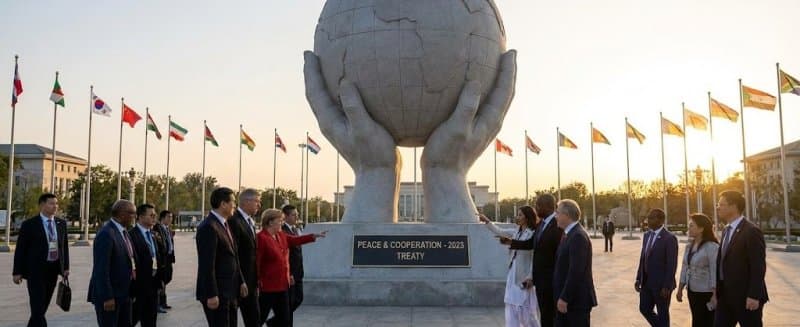

International agreements are formal, legally binding instruments that define the mutual rights and obligations of states or supranational organizations. They play a decisive role in the stability of international relations, trade flows, border security, and environmental protection mechanisms.
How Are International Agreements Defined?
International agreements are binding norms recognized under international law and created when states express their mutual consent through a written instrument. Although these norms are referred to in diplomatic practice by different names, such as “treaty,” “convention,” “protocol,” and “charter,” their legal effects are assessed primarily on the basis of the parties’ intent and the relevant implementation mechanisms. What matters, therefore, is not the name of an agreement but the obligations it creates and how it is implemented.
According to data from the International Law Commission, more than 70,000 multilateral and bilateral agreements are registered with the UN. This figure shows that relations between states are largely governed by written, negotiated norms.
The Position of Agreements Within International Law
Along with customary law, general principles of law, and international court decisions, international agreements are among the main pillars of the global legal order. In particular, the 1969 Vienna Convention on the Law of Treaties clearly established standards governing states’ capacity to conclude agreements, validity requirements, methods of interpretation, and termination procedures. By improving the consistency of both bilateral and multilateral diplomatic instruments, this framework makes dispute resolution more predictable.
The Place of Agreements in the Normative Hierarchy
Not every agreement carries the same legal weight. Human rights conventions, for example, are treated in many countries as norms with a status close to that of the constitution, whereas technical cooperation protocols are regarded as lower-level implementing instruments. This distinction stems not only from differences in subject matter but also from how states incorporate agreements into their domestic legal systems. In some countries, agreements apply directly under domestic law, while other systems require parliamentary approval and implementing legislation.
What Are the Types of International Agreements?
International agreements are divided into different categories according to the number of parties, their degree of legal binding force, their duration, and their subject matter. These distinctions make agreements easier to interpret and implement.
Multilateral Agreements
Multilateral agreements are concluded by three or more parties and play a central role in global governance. Instruments such as the Paris Climate Agreement, the World Trade Organization Agreement, and the Geneva Conventions regulate the collective interests of states. Multilateral agreements generally involve lengthy negotiations, and their participation procedures are clearly defined. Reservations, opt-outs, and compliance mechanisms are particularly important in these instruments.
Bilateral Agreements
Bilateral agreements between two states are the most common form in practice. They are used in many areas, including trade, visa arrangements, border management, military cooperation, and cultural exchange. These instruments tend to contain more technical detail tailored to the parties’ specific needs, while their entry-into-force procedures are generally kept simple.
Non-Binding International Instruments
These instruments, known as soft law, may take the form of declarations, letters of intent, or policy frameworks. Although they do not create legal obligations, they have a major influence on the development of standards of conduct. In the field of human rights, the 1948 Universal Declaration of Human Rights is one of the strongest examples in this category.
Types of Agreements by Scope
- Human rights agreements: They contain fundamental norms such as those set out in the International Covenant on Civil and Political Rights.
- Trade agreements: They establish rules on tariffs, quotas, and standards for trade in services.
- Environmental agreements: They create global commitments concerning greenhouse gas emissions, biodiversity, and ocean governance.
- Defense and security agreements: They cover military cooperation, intelligence sharing, and joint exercises.
- Technology and scientific cooperation agreements: They regulate areas such as artificial intelligence standards, nuclear safety, and space research.
How Are International Agreements Concluded?
International agreements are created through a staged process extending from diplomatic negotiations to ratification. Each stage has a legal basis, and following these steps properly is critical to the agreement’s validity.
When concluding an international agreement, states follow the stages of drafting, negotiation, adoption, signature, and ratification. This structure safeguards the legitimacy requirements established by international law.
Negotiation Stage
Negotiations are generally conducted by expert delegations. Climate scientists participate in environmental agreements, military analysts in defense agreements, and economic modeling experts in trade agreements. At this stage, the factors shaping the parties’ positions include national security priorities, economic interests, and regional balances. Some negotiations may be completed within a few months, while certain large-scale agreements may take 5–10 years.
Adoption and Signature
Once the parties agree on the text, the agreement is adopted. A signature indicates a state’s intention to be bound by the agreement, but in most systems the agreement does not become binding upon signature. Except in certain cases, a signature therefore constitutes only a diplomatic declaration. Article 12 of the Vienna Convention clearly defines the significance of a signature.
Ratification and Entry into Force
Many states require parliamentary approval before agreements become binding. During this process, the agreement is reviewed, its compatibility with domestic law is assessed, and implementing legislation is prepared where necessary. The agreement enters into force when the instrument of ratification is delivered to the depositary. Multilateral agreements generally require ratification by a specified number of states before entering into force.
Execution and Implementation Mechanisms
Technical commissions, joint monitoring units, arbitration panels, or international courts oversee the implementation of agreements. Under the European Convention on Human Rights, for example, the European Court of Human Rights reviews individual applications and issues binding judgments. Carbon reporting systems and periodic review cycles, meanwhile, play an important role in environmental agreements.
Interpretation of International Agreements
The interpretation of agreements is critical to preventing differing perceptions among the parties and is governed by specific legal rules.
International agreements are interpreted using a holistic methodology that considers textual interpretation, purposive interpretation, and contextual analysis together. This approach both reduces legal uncertainty and makes agreements more workable.
Textual Interpretation
Textual interpretation is based on the plain meaning of the text. This method is frequently used for commercial agreements or border arrangements containing technical provisions. Word choice, linguistic context, and consistency among official versions are integral to this method.
Purposive Interpretation
Purposive interpretation examines the objective for which the text was created. It is particularly influential in environmental, human rights, and peace agreements because their underlying aim is to achieve broad social benefits. The drafting process, negotiating documents, and statements by competent bodies are taken into account in this form of interpretation.
Contextual and Systematic Interpretation
Agreements are often not read in isolation; they are assessed in conjunction with other relevant international instruments. This is especially evident in regional organizations. In European Union law, directives, regulations, and implementing decisions are interpreted in relation to one another. This systematic relationship helps sustain legal harmonization.
Why Is Implementing International Agreements Difficult?
Implementation is the most critical stage in determining the success of agreements. Differences in national interests, limited technical capacity, and political instability can make implementation difficult.
The main difficulty in implementing international agreements is that the sovereignty priorities of states do not always align fully with their global obligations. This may affect both the timing and scope of an agreement’s implementation.
Sovereignty and Compliance Issues
States may face domestic political pressure when implementing certain obligations. Commitments to reduce carbon emissions, for example, may create tensions with economic sectors in some countries. In such cases, adding reservations to agreements or establishing flexibility mechanisms becomes important.
Technical Limitations
In highly specialized areas such as environmental reporting, cybersecurity cooperation, or biometric data sharing, some states may be unable to implement agreements fully because they lack technical capacity. Modern agreements therefore include technical assistance funds and capacity-building programs.
Monitoring and Dispute Resolution
Ineffective monitoring mechanisms weaken the impact of agreements. Violations are less common within institutions that have strong dispute resolution systems, such as the World Trade Organization. Independent arbitration panels and transparent reporting systems are therefore critical components of implementation.
Compliance Issues in Multilateral Agreements
In multilateral agreements, it can be difficult for states with different economic and political structures to fulfill the same obligation. The principle of “common but differentiated responsibilities” is therefore frequently used to establish a balance in environmental law.
Invalidation, Suspension, and Termination of International Agreements
Every agreement may encounter unexpected problems during implementation. The Vienna Convention sets out in detail the circumstances in which an agreement may be invalidated, suspended, or terminated.
An international agreement may be terminated for reasons such as mutual consent of the parties, material breach, notice of termination, or a fundamental change of circumstances. This process is subject to procedural requirements and cannot be conducted arbitrarily.
Termination by Mutual Consent
The states parties may terminate an agreement by issuing a joint notification. This method is generally preferred for technical and temporary agreements.
Material Breach
A state’s serious breach of its fundamental obligations under an agreement gives the other states the right to suspend the agreement. The production of prohibited weapons under a disarmament agreement is one example.
Fundamental Change of Circumstances
This doctrine, known as rebus sic stantibus, applies when the circumstances forming the basis of an agreement change fundamentally. However, it is applied only in very limited circumstances and under strict conditions because it has the potential to undermine the predictability of international law.
Fixed-Term Agreements
Some agreements are concluded for a specified period and expire automatically at the end of that period. This method is particularly common in joint investment projects and technical cooperation instruments.
The Effects of International Agreements and Their Contribution to the Global Order
International agreements are among the most important regulatory instruments of the modern state system. They produce tangible results across a wide range of areas, from economic growth and human rights protection to security policy and management of the climate crisis.
International agreements contribute to the global order primarily by enabling states to interact under predictable, transparent, and accountable rules. These rules both enhance the security of economic investments and reduce the risk of conflict.
Impact on Peace and Security
Disarmament agreements, ceasefire protocols, and border arrangements reduce the risk of conflict. Data from the Stockholm International Peace Research Institute show that security agreements with strong monitoring mechanisms reduce tensions by approximately %25.
Economic Interaction
Trade agreements accelerate investment flows between states by reducing customs tariffs. Economic cooperation arrangements increase foreign capital inflows and strengthen financial stability.
Environmental Protection
Instruments such as the Paris Climate Agreement and the Convention on Biological Diversity play a critical role in reducing environmental degradation. The significant slowdown in the annual growth rate of global carbon emissions following participation in these agreements demonstrates the impact of cooperation mechanisms.
Human Rights Outcomes
International human rights conventions make rights violations visible through individual application systems and international monitoring mechanisms. This visibility encourages states both to reform their domestic laws and to improve their practices.
Scientific and Technological Cooperation
The establishment of common norms in areas such as space research, artificial intelligence standards, and nuclear safety protocols makes technological progress safer and more sustainable.
Table Showing the Key Elements of International Agreements
The table below provides a straightforward overview of the structural components of agreements.
| Element | Description |
|---|---|
| Parties | States or international organizations |
| Subject Matter | The legal and technical area being regulated |
| Obligations | Rules with which the parties must comply |
| Monitoring Mechanism | Institutions that monitor implementation |
| Dispute Resolution | Arbitration, judicial, or diplomatic methods |
| Termination/Suspension | Conditions under which the agreement ends |